Best Phono Preamps for Turntables in 2026
Have you ever hooked up your new turntable, dropped the needle on your favorite record, and been greeted by a faint, lifeless sound? It’s a moment of pure disappointment that many vinyl newcomers face. You might think your speakers are broken or the player is faulty, but the culprit is usually much simpler: a weak signal.
Unlike digital audio sources, turntables produce a very low-voltage signal that regular speakers and amplifiers just can’t handle on their own. This is where a quality phono preamp steps in to save the day. Acting as the unsung hero of your Hi-Fi setup, a preamp boosts that tiny signal to a listenable level while correcting the equalization curve to ensure your music sounds rich, dynamic, and true to the original recording.
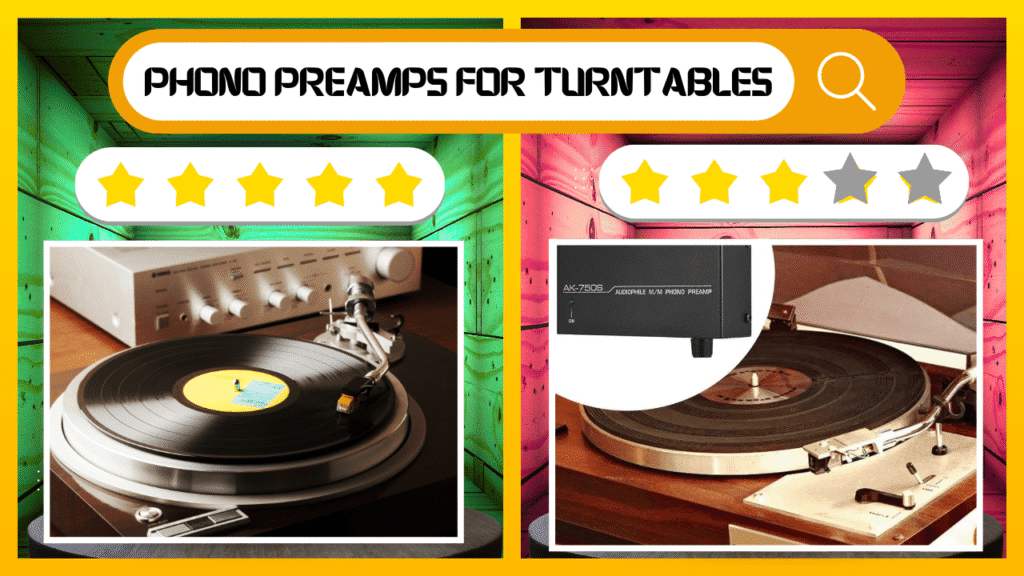
If you are ready to unlock the full potential of your vinyl collection, you are in the right place. In this guide, we will cut through the technical jargon and help you navigate the world of audio equipment. Whether you are searching for a budget-friendly fix or an audiophile-grade upgrade, we will help you find the best phono preamp for your turntable, budget, and unique listening style in 2026.
What Is a Phono Preamp and Why You Need One
Why turntables need signal amplification
The physics of vinyl playback relies on a diamond stylus tracking tiny grooves in a record. This mechanical movement generates an electrical signal, but it is incredibly quiet—often thousands of times quieter than the signal from a CD player or streaming device. Without help, your amplifier simply cannot “hear” the music loud enough to amplify it for your speakers.
Read also AV123 X-Statik Review
Difference between phono preamp and standard amplifier
A standard amplifier (or receiver) is designed to take “line-level” signals—standardized, strong signals from phones, DACs, or CD players—and make them loud enough for speakers. A phono preamp performs a different, specialized task: it takes the “phono-level” signal (the weak one) and boosts it up to “line-level” so your main amplifier can do its job.
How a good preamp improves vinyl sound quality
Beyond just volume, a preamp applies the RIAA equalization curve. Records are cut with reduced bass and boosted treble to save space on the vinyl disc. A phono preamp reverses this process, boosting the bass and cutting the treble to restore the original sound. A high-quality preamp does this with greater precision, resulting in deeper bass, clearer highs, and a wider soundstage.
Built-in vs external phono preamps
Many modern turntables come with a built-in preamp. While convenient, these are often basic components made to keep costs low. An external preamp is a dedicated device with better circuitry, isolated power supplies, and superior components, offering a significant upgrade in audio clarity and detail.
MM vs MC Phono Preamps Explained
Moving Magnet cartridges and compatibility
The Moving Magnet (MM) cartridge is the most common type found on turntables today. They produce a relatively higher output voltage, making them easier to amplify. Most entry-level and mid-range phono preamps are designed specifically for MM cartridges.
Moving Coil cartridges and gain requirements
Moving Coil (MC) cartridges are generally favored by audiophiles for their precision and detail, but they produce an even weaker signal than MM types. Because the signal is so faint, they require a preamp with much higher gain capabilities to boost the sound without adding noise.
Switchable MM/MC preamps
Some versatile preamps offer a switch or button to toggle between MM and MC modes. This is an excellent feature for enthusiasts who plan to upgrade their cartridge down the road. It ensures your preamp remains useful even if you switch from a standard MM cartridge to a high-end MC one.
Which type is best for beginners
For almost all beginners, an MM-compatible preamp is the right choice. Most turntables under $1,000 come with MM cartridges. Unless you know specifically that you have a Moving Coil cartridge, stick with MM or a switchable unit for maximum flexibility.
Read also Fosi Audio BT20A Review
What to Look for in a Phono Preamp (Buying Guide 2026)
Gain levels and noise control
Gain is the amount of boost the preamp provides. Too little gain creates quiet, thin sound; too much can cause distortion. Equally important is noise control. You want a “quiet” preamp that doesn’t add a hiss or hum to the background of your music.
RIAA accuracy and sound neutrality
The primary job of the preamp is to restore the natural sound of the recording. Look for units praised for RIAA accuracy. This ensures you are hearing the album exactly as the artist and engineer intended, without artificial coloring of the tone.
Input impedance and cartridge matching
Impedance matching is crucial for electrical efficiency. For MM cartridges, the standard is 47k Ohms. MC cartridges vary more wildly. A good preamp will match these standards or offer adjustable settings to fine-tune the electrical relationship between your turntable and the preamp.
Build quality and shielding
Audio signals are sensitive to interference from Wi-Fi, power cables, and other electronics. A well-built preamp often features a metal chassis which acts as a shield (Faraday cage), protecting the delicate audio signal from outside radio frequency (RF) interference.
Connectivity and output options
Most preamps use standard RCA cables. However, some high-end models offer balanced XLR outputs for studio-grade connections, or USB outputs for digitizing your vinyl collection to a computer.
Power supply design
Ideally, the power supply should be isolated from the sensitive audio circuitry to prevent “hum.” Many quality units use an external power brick (wall wart) to keep the noisy AC power transformation far away from the audio path.
Upgrade potential and long-term reliability
Investing in a slightly better preamp now can save you money later. A unit with adjustable gain and loading settings can adapt to almost any turntable or cartridge upgrade you make in the future.
Best Phono Preamps for Turntables in 2026
1. Schiit Mani 2 – Best Overall Value
The Schiit Mani 2 is widely regarded as the king of value. It offers adjustable gain settings that allow it to work with virtually any cartridge, MM or MC. The build is solid, the noise floor is incredibly low for the price, and the sound is punchy and detailed.
- Best For: Everyone from beginners to serious hobbyists.
- Pros: High versatility, excellent sound, affordable.
- Cons: Power switch is on the back.
- Soft CTA: Check today’s latest price on Amazon.
2. Pro-Ject Phono Box S2 – Best for Audiophiles
Compact but mighty, the Phono Box S2 brings true audiophile performance to a small footprint. It features a dual-mono configuration for superior stereo separation and extensive dip switches on the bottom for precise cartridge matching.
- Best For: Listeners who love tweaking settings for perfect sound.
- Pros: Incredible detail, highly adjustable, compact metal case.
- Cons: Dip switches are tiny and hard to change.
- Soft CTA: See full customer reviews here.
3. Cambridge Audio Alva Solo – Best for MM Cartridges
If you know you’ll stick with Moving Magnet cartridges, the Alva Solo is a sleek, stylish option with a warm, engaging sound signature. It includes a built-in balance control to fix cartridge imbalances and an auto-power down feature for eco-conscious listeners.
- Best For: Users who want a “set it and forget it” solution.
- Pros: Beautiful design, warm sound, subsonic filter.
- Cons: No MC support.
- Soft CTA: Check pricing and availability.
4. iFi Zen Phono – Best for MM and MC Support
The iFi Zen Phono looks like a spaceship and sounds out of this world. It boasts a circuit design trickle-down from much more expensive gear, resulting in an eerily quiet background noise level. It handles both MM and MC with ease.
- Best For: Those seeking a modern aesthetic and super-clean sound.
- Pros: Ultra-low noise, balanced output options, unique design.
- Cons: Shape might be awkward to stack with other gear.
- Soft CTA: View current deals on Amazon.
5. Behringer PP400 – Best Budget Phono Preamp
The PP400 is the ultimate problem solver for tight budgets. It’s small, simple, and gets the job done. While it lacks the nuance of the pricier options, it successfully boosts the signal to line level without breaking the bank.
- Best For: Students or anyone needing a quick, cheap fix.
- Pros: Extremely cheap, compact, easy to use.
- Cons: Basic sound quality, plastic build.
- Soft CTA: Get yours for a bargain price today.
Comparison Table – Best Phono Preamps 2026
| Model | Gain Range | MM / MC | Noise Level | Best Use Case |
|---|---|---|---|---|
| Schiit Mani 2 | Adjustable | Both | Low | Best Overall Value |
| Pro-Ject Phono Box S2 | Adjustable | Both | Very Low | Audiophile Tweaking |
| Cambridge Audio Alva Solo | Fixed | MM Only | Low | Pure MM Listening |
| iFi Zen Phono | Adjustable | Both | Ultra Low | Modern Systems |
| Behringer PP400 | Fixed | MM Only | Moderate | Tight Budgets |
Built-In Phono Preamp vs External Phono Preamp
When a built-in phono stage is enough
If you are just starting out with a turntable like the Audio-Technica LP60X and using small powered speakers, the built-in preamp is likely sufficient. At this level, the difference in sound quality from an external unit might not be audible.
Sound quality differences
As your speakers and turntable improve, the built-in preamp becomes a bottleneck. External preamps offer better dynamics (the difference between quiet and loud sounds) and a wider frequency response. The music feels more “open” and less compressed.
Upgrade flexibility
An external preamp allows you to upgrade your sound without buying a whole new turntable. It is one of the most cost-effective upgrades in the vinyl hobby.
Cost comparison
Built-in preamps are essentially “free,” but you pay for them in compromised audio quality. External preamps range from $20 to $2,000+, but the “sweet spot” for most people is between $100 and $200.
Read also Best 5 CD Players
Best Turntable Pairings for These Phono Preamps
Audio-Technica AT-LP120X
This popular deck has a built-in preamp, but bypassing it for the Schiit Mani 2 opens up the soundstage significantly.
Pro-Ject Debut Carbon EVO
This high-quality table deserves a partner like the Pro-Ject Phono Box S2 to truly shine and extract every detail from the grooves.
Rega Planar 1
Rega tables are famous for their timing and rhythm. The Cambridge Audio Alva Solo complements this energy perfectly.
Fluance RT85
With its acrylic platter and Ortofon 2M Blue cartridge, the RT85 is incredibly detailed. The iFi Zen Phono ensures that detail isn’t lost in background noise.
Setup Guide – How to Connect a Phono Preamp
Correct cable connections
- Connect the RCA cables from your turntable into the INPUT of the phono preamp.
- Connect another set of RCA cables from the OUTPUT of the preamp to an AUX, CD, or LINE input on your amplifier or powered speakers.
- Crucial: Do NOT plug into the “Phono” input on your amp if you are using an external preamp.
Ground wire setup
Most turntables have a thin forked wire separate from the RCA cables. Connect this to the grounding post (usually a metal screw) on your preamp to prevent a loud, persistent humming noise.
Gain adjustment tips
If your preamp has adjustable gain, start with the lowest setting. If the volume is much quieter than your streaming music, bump it up one level. Avoid setting it too high, or you will hear distortion during loud passages.
Avoiding hum and interference
Keep your phono preamp away from your amplifier’s power transformer and Wi-Fi routers. Do not run the audio cables parallel to power cords; if they must cross, cross them at a 90-degree angle.
Common Phono Preamp Problems and Fixes
Buzz or hum noise
This is almost always a grounding issue. Check that your ground wire is tight on both the turntable and preamp ends. If the hum persists, try moving the preamp to a different location.
Distortion at high volume
This usually means your gain is set too high. Lower the gain setting on the preamp. If it’s a fixed-gain preamp, check if your cartridge output is too hot (high voltage) for that specific model.
Low output levels
Conversely, if you have to turn your amp to max volume to hear anything, your gain is too low. This often happens if you plug an MC cartridge into an MM input.
Channel imbalance
If one speaker is louder than the other, swap the Left and Right cables. If the quiet side switches, the issue is the turntable or preamp. If it stays on the same side, the issue is your speakers or amp.
FAQs
Do I need a phono preamp if my amp has one?
Technically, no. However, the external preamp is likely of higher quality than the one built into your receiver, offering better sound.
Is an expensive phono preamp worth it?
It depends on your system. If you have a $100 turntable, a $500 preamp is overkill. The preamp should roughly match the quality tier of your turntable and speakers.
Can a phono preamp improve cheap turntables?
Yes, but there is a limit. It can clarify the signal, but it cannot fix mechanical noise or poor tracking from a very cheap turntable.
Do phono preamps affect vinyl warmth?
Yes. Tube-based preamps add a lot of “warmth” (harmonic distortion), while solid-state preamps (like those listed here) aim for accuracy and clarity.
How long does a phono preamp last?
Solid-state electronics are very durable. A good preamp can easily last 10–20 years or more without degrading in sound quality.
Conclusion
A phono preamp might seem like a boring grey box, but it is the critical bridge between your vinyl and your ears. It takes a fragile, whisper-quiet signal and transforms it into the rich, warm music we all love. Without it, your records simply can’t sing.
For most listeners in 2026, the Schiit Mani 2 offers the best balance of price and performance, while the Behringer PP400 remains the champion for budget setups. Whatever you choose, moving away from a basic built-in preamp is one of the best upgrades you can make for